Increasing Resolution of MRI Volumes Through Interleaved Slice Synthesis Based on Generative Adversarial Networks
Abstract
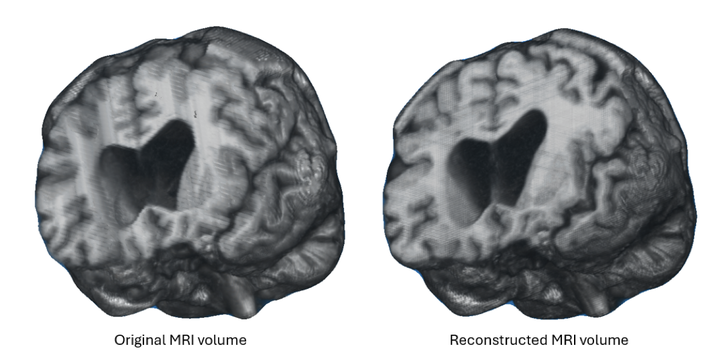
In modern medical diagnostics, Magnetic Resonance Imaging (MRI) has emerged as an indispensable tool, playing a fundamental role in diagnosing several diseases. However, the widespread use of dated diagnostic machinery often results in MRI scans of limited slice count and suboptimal quality. Such limitations can considerably impede diagnostic accuracy, particularly in complex cases like small lesion detection, early-stage tumor identification, and fine structural anomalies. Enhancing the resolution and overall image quality of these MRI scans holds the potential to boost diagnostic precision for an array of conditions significantly. Furthermore, the rise of deep learning AI techniques for segmentation and classification has amplified the need for large datasets, ensuring that models can effectively generalize across diverse imaging scenarios. In recent times, Generative Adversarial Networks (GANs) have garnered attention for their ability to generate high-fidelity synthetic images, which could potentially bridge the gap between existing diagnostic needs and the current limitations of MRI scans. This paper introduces a new GAN architecture designed to enhance the resolution of MRI volumes for detailed structure analysis, synthesizing new slices from existing adjacent ones in the MRI volume. Such a system increases data quantity and broadens the model’s adaptability, enhancing modeling accuracy. The experiments demonstrate superior accuracy, robustness, and computational efficiency compared to traditional methods.